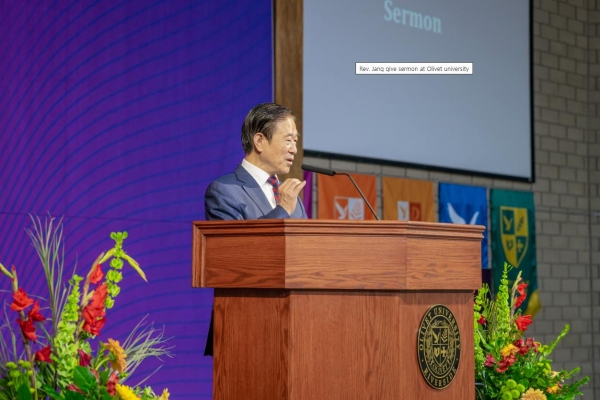
1. The Age of the Holy Spirit and New Fruitfulness
Centering on the precious Word from John 15:8-"This is to my Father's glory, that you bear much fruit, showing yourselves to be my disciples"-Pastor David Jang proclaimed the significance of a "fruit-bearing life" and the "beginning of a new seven-year period" as an important spiritual milestone. He particularly connected this with Jesus' words in John 14, where the Lord says, "The age of the Holy Spirit is coming, and the Spirit will teach you all things and help you understand." The Holy Spirit is our Advocate, the One who makes the love and truth of Jesus Christ rise within our hearts so that we can live "in Christ." Pastor David Jang explained in detail how the Holy Spirit acts concretely in the church and in individual believers to bear fruit, and how that fruit brings glory to God the Father and makes us true disciples of Jesus Christ.
Pastor David Jang first gave a brief overview of how redemptive history has progressed from the Old Testament era through the New Testament era, ultimately arriving at the current "church age." The Old Testament was a time when God the Father worked through His "Word" and through the "messengers" He sent; then came Jesus Christ, who personally came to this earth, taught the truth, died, and rose again, completing the "big picture" of redemption. After Jesus ascended, He promised, "When I depart, the Father will send you the Advocate, the Holy Spirit." This Holy Spirit teaches and leads the church, enlightens believers to understand the Word, and purifies the lives of the saints. Thus, Pastor David Jang stressed that now-when we enter a new year and a new seven-year cycle-is precisely the time for all of us to seek more deeply the "indwelling of the Holy Spirit."
Referring to John 14, Pastor David Jang explained that Jesus' declaration, "I am the way, and the truth, and the life" (John 14:6), is further developed in John 15 when Jesus says, "I am the true vine, and you are the branches" (John 15:5). By remaining in Christ, who is "the way," "the truth," and "the life," we receive the power of life and the power of truth. Yet it doesn't stop there. Only when the branches remain connected to the vine and produce abundant fruit can they be called true disciples who bring glory to God the Father. This is the fervent message of John 15 as a whole. And the One who helps us in that fruit-bearing process is the Holy Spirit, our Advocate. The Holy Spirit teaches our lives, awakens us to grace, and continually reminds us of the love of Jesus Christ. Pastor David Jang strongly proclaimed that today's church must truly remain awake in the Word, through the Holy Spirit; then, like seed sown on good soil, we will produce a crop yielding thirty, sixty, or a hundred times what was sown.
Additionally, Pastor David Jang noted that if we look at the declaration in John 15:8-"This is to my Father's glory, that you bear much fruit, showing yourselves to be my disciples"-in reverse, we discover that those who become true disciples of the Lord will indeed bear abundant fruit. This bearing of fruit is not simply about outward "church growth" or "financial abundance," but it refers to the various and profound fruits of the Holy Spirit revealed throughout the believer's character and overall life, such as holiness, sacrifice, and a spirit of service. Just as the person who buried his one talent was rebuked, and as in the Parable of the Sower where seeds that fell on good soil bore abundant crops, the life of a saint is purified in the Holy Spirit and becomes mature grain as we hold on to God's Word. The result is that the church becomes salt and light in the world-truly caring for the poor and marginalized, sharing, and weeping and rejoicing together, thereby embodying "the love of Christ."
How, then, can we move toward such fruit-bearing faith? Pastor David Jang suggested reading together "the Parable of the Wild Grapes" in Isaiah 5 (Old Testament) and "the Parable of the True Vine" in John 15 (New Testament). In Isaiah 5, God laments that even though He carefully cultivated the land, fertilized it, and established a vineyard, instead of the good grapes He had expected, it produced wild grapes. Wild grapes are small, full of seeds, and yield no useful fruit. Thus, without God changing the seed, humanity, with its inherent sin nature, cannot bear good and holy fruit. In the New Testament, we see God's salvation through Jesus Christ, who grafts onto us a "new shoot." Like Paul's declaration in Galatians 2:20, "I have been crucified with Christ and I no longer live, but Christ lives in me," we must be united with Christ to bear new fruit. The seed itself must change.
However, Pastor David Jang emphasizes that the crucial point is not merely repeating the term "seed improvement"; rather, it is truly connecting with Christ's death on the cross and His resurrection in such a way that His death becomes ours and His resurrection becomes ours. We accept the reality of this union by faith. This faith is the central truth proclaimed in numerous Bible verses that speak of "In Christ." It is the Holy Spirit who brings about the actual experience of salvation for believers in this "age of the Holy Spirit," uniting us spiritually with Christ's life, death, resurrection, and ascension.
Pastor David Jang also quoted 2 Corinthians 5:17-"Therefore, if anyone is in Christ, the new creation has come: The old has gone, the new is here!"-arguing that this statement from Paul is an eschatological proclamation. We are renewed daily in Christ, liberated from the sinful nature of our old self and from past bondage. Yet being set free does not mean we can live however we want. We must keep God's command, "Be holy, because I am holy," and proceed with discipline that breaks with sin and purifies ourselves. Being a new creation is not just a matter of confession but of living out holiness in fellowship with the Holy Spirit.
Citing Romans 11:29-"God's gifts and his call are irrevocable"-and John 15:16-"You did not choose me, but I chose you and appointed you"-Pastor David Jang underscored that God's choice and calling for us is part of an eternal plan. It's not that we chose God; rather, the Lord foreknew us and predestined us. Moreover, God's purpose in choosing us is "that we would bear fruit." "I chose you and appointed you so that you might go and bear fruit-fruit that will last-and so that whatever you ask in my name the Father will give you" (John 15:16) attests to this. Hence, those chosen are not called to remain idle but rather to fulfill a "mission of bearing concrete fruit that brings glory to God." It is the Holy Spirit who helps and teaches us to accomplish this calling.
Regarding the new seven-year period, Pastor David Jang cited the story of the Israelites finally entering the land of Canaan after wandering in the wilderness for forty years and reaping abundant harvests there. In the wilderness, they only ate manna and lived a nomadic life, so great produce was hard to expect. But once they entered the land God had promised, they sowed seeds, cultivated them, and harvested abundant grain and fruit-experiencing "practical abundance." At the moment they ate of the produce, the manna from heaven ceased. This signified that one era had ended and a new era had begun. In the same way, if the church has gone through a season of training like a wilderness journey, we are now called to a time of harvest and abundance. Pastor David Jang urged us to believe and prepare for this season of fruitfulness.
Nevertheless, Pastor David Jang stressed that the more crucial point in a season of fruitfulness is "testing." As shoots sprout and heads of grain appear, one can begin to distinguish the genuine from the weeds. If a church strays from its essence and takes the path of secularization, or if it operates purely based on excitement and entertainment, neglecting theological or ethical testing, it could become like weeds, sowing confusion rather than fruit. Therefore, a solid foundation of "Faith & Order" must be laid for the church to grow abundantly. Doctrine and ethics, worship and service must be firmly established. Pastor David Jang explained that a church with proper order will endure the stages of sprout-ear-mature grain and eventually stand firm as the community of God's new kingdom from an eschatological perspective.
He then returned to John 15, highlighting Jesus' statement, "I am the true vine, and my Father is the gardener." Christ, the "true vine," and we, the "branches," share a most intimate and inseparable union. Scripture describes this in various metaphors: "Christ is the head of the church, and we are the members of His body," or in agricultural language, "the vine and the branches." This speaks of a relationship so close that it is impossible to separate-where the transfer of life occurs directly. Furthermore, "He cuts off every branch in me that bears no fruit, while every branch that does bear fruit he prunes so that it will be even more fruitful" (John 15:2) implies that each believer must pursue "cleanness," or holiness. The purpose of pruning is to bring forth more fruit, not to arbitrarily hurt the branch. Pastor David Jang referred to this pruning as "holiness training," describing the real-life process of repenting of sins before God and cutting off worldly desires.
When a person becomes wealthy and comfortable, opportunities for sin and temptation increase. Worldly pleasures and temptations enter through our eyes, ears, and hearts, posing a greater risk of spiritual defilement. Pastor David Jang warned, "In the wilderness, you have many shortages, so you can do nothing but rely on God, but in times of abundance, one can become proud." Deuteronomy 8 likewise admonishes people not to forget God when they prosper, for this caution penetrates our heart's reality. Thus, faith becomes even more vital now, and a commitment to deny oneself and take up the cross is needed. Holiness is attained through a repeated cycle of daily renewal by the Holy Spirit and putting sin to death.
Pastor David Jang specifically mentioned Jesus' radical teaching to "pluck out your right eye if it causes you to sin, and cut off your right hand if it leads you to sin." The key message: "Cut off the channels through which sin enters." Of course, it doesn't literally mean to mutilate ourselves, but rather to vigilantly guard against sin's entrance. This is because sins that enter through our eyes can quickly translate into actions, leading to more sins, ultimately polluting the mind and spirit. In an age with so many open windows to the world, the temptations of the internet and media are legion. Hence, training is essential. Pastor David Jang cited an example of a mission organization whose leaders do a three-day fast at the start of every year, during which they often experience breaking free from worldly desires. He emphasized that such thorough separation-voluntarily cutting oneself off from certain influences-is necessary for our souls.
When that commitment to purity precedes it, the fruit of the Holy Spirit is borne in abundance. As Galatians 5:22-23 says, "the fruit of the Spirit is love, joy, peace, patience, kindness, goodness, faithfulness, gentleness, and self-control." This inward fruit naturally manifests in our lives, and the church exerts a positive influence on the world. Pastor David Jang noted that this journey is never easy, but since Jesus Christ has opened the way through the cross and the Holy Spirit abides in us daily, renewing us, it is indeed possible.
Recalling a word he received last year, Pastor David Jang touched on the process of Noah building the ark with gopher wood, making rooms, and coating it with pitch so no water could seep in. That process finished, it was time to "fill" the ark. Likewise, in the Wedding at Cana, when they filled the jars to the brim, Jesus turned the water into wine. Pastor David Jang urged believers to fill our hearts, hands, and feet with God fervently, believing that the Lord will transform it. If the church has a vision for the world-helping the poor and marginalized and carrying out concrete ministries-then that vision must be backed up by "holiness," "the Word," and "prayer," equipping ourselves spiritually to carry it out.
He further cautioned that as the church expands its missions to many countries and broadens its services in education, volunteer work, and outreach, it must be even more dedicated to remaining pure. Wealth and prosperity are gifts from God, but we must remain alert so that we do not fall into the "idolatry of Canaan." Pastor David Jang mentioned many cases where a church, once it becomes wealthy, can lose its essence, becoming proud and self-centered. Earning money, growing financially, constructing buildings, and pioneering new mission fields are indeed joyful and praiseworthy; yet we must continually remember that the ultimate purpose of it all is to glorify God and serve people. He stressed that to prevent this vision from becoming muddled, we must "discipline ourselves daily" to remain humble. That is how the church obeys the command, "Be holy, because I am holy."
In this vein, Pastor David Jang summarized the attitude we need at the starting line of this new seven-year period in two main points. First, we must long for the Holy Spirit and diligently integrate the Word into our daily lives through the Spirit. Second, to experience the reality of "In Christ," we must thoroughly repent of sin and daily nail our past bondages, wounds, and dark habits to the cross. Without such commitment, old wounds, guilt, and former ways of living continue to hold us back. The gospel proclaims our death with Christ and our new life with Him, so if our past resurfaces daily to oppress us, it suggests a part of us has not died yet. He urged believers to truly apply Galatians 2:20-"I have been crucified with Christ"-in a practical sense.
We now stand before the words, "This is to my Father's glory, that you bear much fruit, showing yourselves to be my disciples" (John 15:8). Pastor David Jang pointed out various concrete ways the church can now move forward-different missions, educational programs, overseas volunteer work, and so forth. As we nurture new students, raise up pastors, train teachers, and work diligently to improve our finances to help those in need, all of this should be viewed within the grand framework of "conveying the love of Christ, spreading the gospel on earth, and realizing the values of the kingdom of God."
Meanwhile, Pastor David Jang also touched upon diverse spiritual and religious claims in the world. For instance, "Heaven and earth have become twisted, so we need to redo the heavenly-earthly project," or "If you chant a certain formula, the epidemic will cease and a new era will open," and so on. He noted that these ideas have a foundation utterly different from "the truth and gospel of Jesus Christ." Although such assertions might sound plausible, he reminded us that true truth flows from the love Jesus showed by giving His life on earth. The proclamation of truth is not separate from truth itself; in the gospel, these are one. This truth is both a person and an event. "The Word became flesh and made His dwelling among us" (John 1:14) is the evidence. Pastor David Jang reiterated that the gospel, in solving the problem of sin, is the fundamental answer, the true source of life for our souls.
What, then, is the secret to bearing fruit? It is not just a matter of "effort" guided by worldly principles, but a faith-based practice rooted in Jesus' promise: "If you remain in me and my words remain in you, ask whatever you wish, and it will be done for you" (John 15:7). Pastor David Jang compared this to plugging in an electrical cord so that electricity can flow. We, as branches, must stay plugged into Jesus, the vine, receiving the sap of life to bear fruit. Ultimately, "How do we more deeply enjoy and live out this united relationship?" is the core of Christian living.
Furthermore, Pastor David Jang illustrated through various examples that only the "fullness of the Holy Spirit" can truly subdue our sinful nature. When the Holy Spirit comes, just as darkness cannot overcome light, sin must depart and the heart is cleansed. Thus, when worship, the Word, prayer gatherings, and communal fellowship are alive with the Holy Spirit, the church and its members distance themselves from worldly sins and keep themselves holy. This is impossible by mere moral codes or sheer determination. Of course, new believers may temporarily benefit from guidelines like "Don't do this or that," but in the end, one must be filled with the Holy Spirit to genuinely conquer the sinful nature.
As this year begins, many Christians talk about "newness" and "hope." Yet Pastor David Jang cautioned that we might become filled with excitement and optimism, neglecting to examine our spiritual condition. While a new beginning is joyful, we must also look inward: "Do I still have parts of the old self that haven't died?" If yes, we must crucify that part thoroughly. Paul said, "I die daily" (1 Corinthians 15:31) because if we fail to examine ourselves every day, the old nature stealthily revives and takes control. We must remember that "putting on the new self" is directly paired with "completely removing the old self," two sides of the same coin.
On that note, Pastor David Jang warned against certain approaches in some churches that repeatedly dig up the past to "heal old inner wounds." True gospel-centered healing, he argued, comes not by analyzing all our past but rather by declaring in faith: "I have already died, and all my sins and wounds were crucified with Christ." Of course, real-life problems continue to arise, but spiritually, we are "beings whose past has been dismantled in Jesus Christ." Only by accepting this can we experience complete freedom and genuine newness.
Jesus' promise-"This is to my Father's glory, that you bear much fruit, showing yourselves to be my disciples"-brings hope to all who have walked through a wilderness-like journey. The church must become a community whose members are all firmly attached to Jesus, the true vine, through the Holy Spirit, bearing abundant fruit. That fruit becomes both glory to God the Father and powerful evidence of the gospel to the world.
It is now somewhat like the Israelites settling in Canaan after wilderness training and reaping harvests. We too can anticipate a rich yield. However, we must not forget that God's gift of abundance is also a time of testing. "Otherwise, when you eat and are satisfied, when you build fine houses and settle down ... then your heart will become proud and you will forget the Lord your God" (Deuteronomy 8:12-14, paraphrased). Pastor David Jang stressed this point, explaining, "Wealth itself is not sin, but in the midst of wealth, people grow proud, trust in their own power, and ultimately lose the essence of faith." Hence, our daily practice must be "returning to the cross, humbling ourselves." Just as Jesus came in the humblest way-born in a manger-we must stand in a posture of service, becoming friends to the weak, caring for them, and thus entering more deeply into spiritual abundance.
This paradox is central to the gospel: We must go lower in order to be raised to a higher place. Paul wrote in Philippians 2 that Christ "emptied himself by taking the very nature of a servant and became obedient to death," and likewise, Pastor David Jang highlighted, "Only if we lower ourselves can we experience the grace of being 'lifted up with the Lord.'" The world prioritizes efficiency and competition, but the gospel points to a path toward glory through love, sacrifice, and service. Thus, no matter how wealthy or institutionally large the church becomes, its essence never changes: "Serving the world by lowering ourselves."
With this in mind, Pastor David Jang emphasized the theme: "The age of the Holy Spirit has dawned; in that age, we bear abundant fruit by uniting with Christ," referencing John 14 and 15, Isaiah 5, Galatians 2:20, 2 Corinthians 5:17, and Deuteronomy 8 as foundational passages. All these Scriptures provide biblical insight into the question, "What kind of identity and purpose should we have in this new era?" In every step, "apart from the Holy Spirit, it is impossible," and we must thoroughly remove "the seeds of sin that remain in us." This is the essence of his first major point.
2. Christ, the True Vine, and Abundant Fruit
Pastor David Jang reiterated John 15:8-"This is to my Father's glory, that you bear much fruit, showing yourselves to be my disciples"-and encouraged us all to lead lives that produce abundant fruit. In particular, the pivotal message of John 15, "I am the true vine and you are the branches" (John 15:5), provides the concrete answer to how believers can become fruit-bearing people.
First, our relationship as branches to Christ, the "true vine," must be inseparably connected. Just as branches cannot bear fruit on their own, humans cannot live holy lives through their own efforts. Only by remaining in Christ through the Holy Spirit can we receive the lifeblood from Him to bear fruit. This reflects the theme of "union" found throughout Scripture-namely, the message of being "In Christ." Both the Gospels and Paul's letters insist that "we become new creatures in Christ," because without such union, we remain "wild grapes" that can't escape our inherent sinful nature.
Pastor David Jang identified "sin and worldliness" as the greatest obstacles to this union. Our sinful nature constantly tries to drag us back into our old ways, and the world's countless temptations enter through our eyes, ears, hands, feet, and our hearts. Hence Jesus used radical language-"If your right eye causes you to sin, gouge it out; if your right hand causes you to sin, cut it off." Pastor David Jang explained that the greatest crisis for believers often is not intense external persecution or adversity but the gradual infiltration of sin and temptation from within. Thus, we need continual "self-denial" and a spirit of "repentance," daily seeking the help of the Holy Spirit to walk on the genuine path of fruitfulness.
Second, the statement "My Father is the gardener" (John 15:1) reminds us that God is the One who tends us. Pastor David Jang found hope in this. Our heavenly Gardener will never abandon us to a fruitless fate. Sometimes we experience the painful process of pruning, but the purpose is that "it may bear more fruit" (John 15:2). God is deeply concerned that we bear fruit and will prune away anything unnecessary for that goal. The problem arises when we try to be our own gardener-organizing life by our own power and plans, which often stem from selfish desires and cause waste. Pastor David Jang underscored that the true life of a believer is to acknowledge God as the Gardener and obey Him.
Third, bearing "fruit" is absolutely necessary. Pastor David Jang explained that our faith cannot remain mere "words" or "doctrine"; it must be proven by real fruit in our lives. This fruit can appear in various ways: the nine fruits of the Spirit in Galatians 5, the fruit of service highlighted in Matthew 25, or the fruit of love in 1 John ("If anyone loves his brother, he truly loves God"). All these refer to different aspects of the fruit of the Holy Spirit that manifest in the believer. More specifically, within the church community, it includes the atmosphere of mutual service between pastors and congregants, the language and demeanor of each person marked by gentleness and patience, and practical compassion such as caring for the poor and marginalized. These all exemplify the fruit of the Spirit.
Pointing to James' teaching that "faith without works is dead" (James 2:17), Pastor David Jang reaffirmed that the church's goal is indeed to bear fruit. And that fruit must be ultimately for God's glory. "This is to my Father's glory, that you bear much fruit" (John 15:8) highlights that all glory goes back to God. Once people start focusing on human pride and worldly recognition, they are akin to independent wild grapes, disconnected from the vine. Hence, we must regularly ask, "Is this truly bringing glory to God?" We must reflect on this together with fellow believers, discerning in light of Scripture.
Pastor David Jang further mentioned that even though our era is changing rapidly in social and cultural aspects, the church must firmly cling to the timeless truth of the gospel while seeking new methods of evangelism and service for new circumstances. "The teaching of the Holy Spirit" is central to this. Human strategies and worldly management principles have limits, but the Holy Spirit gives the church clear wisdom on where to go. As Jesus said before leaving, "The Advocate, the Holy Spirit ... will teach you all things and will remind you of everything I have said to you" (John 14:26). In this age of the Holy Spirit, prayer and the Word give the church constant renewal of vision.
Though we welcome a season of harvest-a source of great joy-this also entails serious responsibility. Pastor David Jang stressed that once we reap abundant fruit, how we use it matters enormously. When the church's finances grow and human resources increase, buildings expand, and more ministries flourish, there is a serious risk of pursuing personal satisfaction and prestige rather than looking after the humble. In Israel's history, David and Solomon led a flourishing era, but pride and idolatry later crept in, culminating in the nation's downfall. Therefore, just because we're bearing fruit and prospering does not guarantee we are bringing glory to God. The more critical question is how we use those fruits and whether we willingly surrender them to God's purposes. For believers, this is a core issue that should remain at the forefront of our hearts.
We must, first, maintain "holiness," second, seek the "fullness of the Holy Spirit," and third, continually deepen our connection to Jesus Christ, "the true vine." Additionally, in daily life, "loving our neighbors, evangelizing, and practicing love" demonstrate tangible fruit. Pastor David Jang reminded us never to forget this.
He also predicted that as this process unfolds, each believer will mature, and the church will become a powerful force for good in society. Notably, he remarked, "We have lived through one generation, not by our own might or wisdom, but by the Spirit-by the Holy Spirit, by the Spirit of God." All past ministries, he confessed, are entirely due to God's grace and guidance, not human methods. He encouraged us to hope that God would open doors for even greater fruitfulness in this new year onward. Drawing another parallel with the Israelites transitioning from wilderness to Canaan-switching from eating manna to enjoying the produce of the land-Pastor David Jang believes we are entering the phase of "actual harvest" that we have not yet experienced.
Nevertheless, to fully enjoy that harvest, "holiness" is indispensable. Pastor David Jang repeatedly pressed the point that "pruning the vine" implies removing anything unclean-just as in a believer's life, "cutting away" sin and worldly influences is essential. Having been forgiven of sin through faith in Jesus Christ, we must go further, cooperating with the Holy Spirit to remove residual bad habits, sinful desires, and old nature. Neglecting this task can lead to the church growing outwardly but becoming inwardly corrupt like wild grapes.
Pastor David Jang encouraged believers to remember that we are "new creatures" (2 Corinthians 5:17), and as such, we must not be bound by our past. If we have truly "died and risen with Christ," then our past failures, sins, and hurts have no authority to rule over us anymore. The issue is our lack of faith in that truth, causing us to revert to old habits. As Paul declared, "I die every day," so must we stand before the cross daily, proclaiming, "Today, too, I crucify my old self." As we repeat that resolution, we build the habit of conquering sin, staying holy, and walking with the Holy Spirit. Only then does the abundant fruitfulness described in John 15 become a reality.
Concluding his sermon, Pastor David Jang said, "A season of fruitfulness and abundance is at hand. Yet only those who humble themselves and remain holy can truly enjoy that abundance." When a church prospers, becomes well-known, gains more resources, and sees membership surge, the danger of human vanity and worldly values infiltrating the church is huge. However, for the church to be a "fruit-bearing community," we must always return to the words, "I am the true vine; you are the branches," focusing solely on Jesus Christ. The identity of believers and the identity of the church can be preserved only in Christ, and only under these conditions does the fruit we bear bring glory to God and offer good news to the world.
John 15:8 is not merely a short slogan for the new year; it is a central verse that defines the "meaning of existence" for every believer living in Jesus Christ: "This is to my Father's glory, that you bear much fruit, showing yourselves to be my disciples." It simultaneously declares that "disciples must bear fruit, and that fruit brings glory to God." Pastor David Jang clung to this truth, hoping that every believer would follow the Holy Spirit's guidance, forsaking sin and seeking holiness daily, and demonstrating genuine love and service in tangible ways, so that the church would live out the fullness of John 15.
We all live in a "special age of grace," the "age of the Holy Spirit." If Jesus had not departed, the Holy Spirit would not have come, and we would not experience this astonishing leap into fruitfulness. Pastor David Jang exhorted the church not to forget this and not to adopt a complacent attitude such as "I've attended church for a long time, so I'll surely bear fruit." God continues to declare judgment on "wild grapes" and anticipates good grapes. Therefore, each of us and the entire church must present ourselves before the Gardener, our God. We must remember that Christ is the "true vine," the Holy Spirit the One who "cleanses and teaches" us. Only in such radical dependence and obedience can we finally bear abundant fruit that glorifies God.
Looking back, we see that everything has happened under God's guidance, not by our own strength or wisdom, but "by the Spirit, by the Holy Spirit, by God's leading." We, therefore, have every reason to keep dreaming. At the same time, as we work to make those dreams real, we must guard against sin and worldliness by returning daily to the cross and seeking the Holy Spirit's help to remain pure and humble. Those who do this will experience even greater joy in bearing fruit. That is how we "keep Jesus' word"-"This is to my Father's glory, that you bear much fruit, showing yourselves to be my disciples"-and respond worthily to God's eternal calling.
Pastor David Jang's emphases can be summarized in two main points. First, recognize that we are in the age of the Holy Spirit, and by living in union with Jesus Christ, we must break away from our past and our sinful nature, pursuing holiness. Second, based on that holiness, bear abundant fruit that brings glory to God. That fruit is the proof of a "true disciple." These were the core messages of his first sermon of the year, which he suggested we continue to uphold not only for the next seven years but for our entire lives. May all who hear this Word truly "bear much fruit" as the Lord has promised, bringing joy and glory to God.